
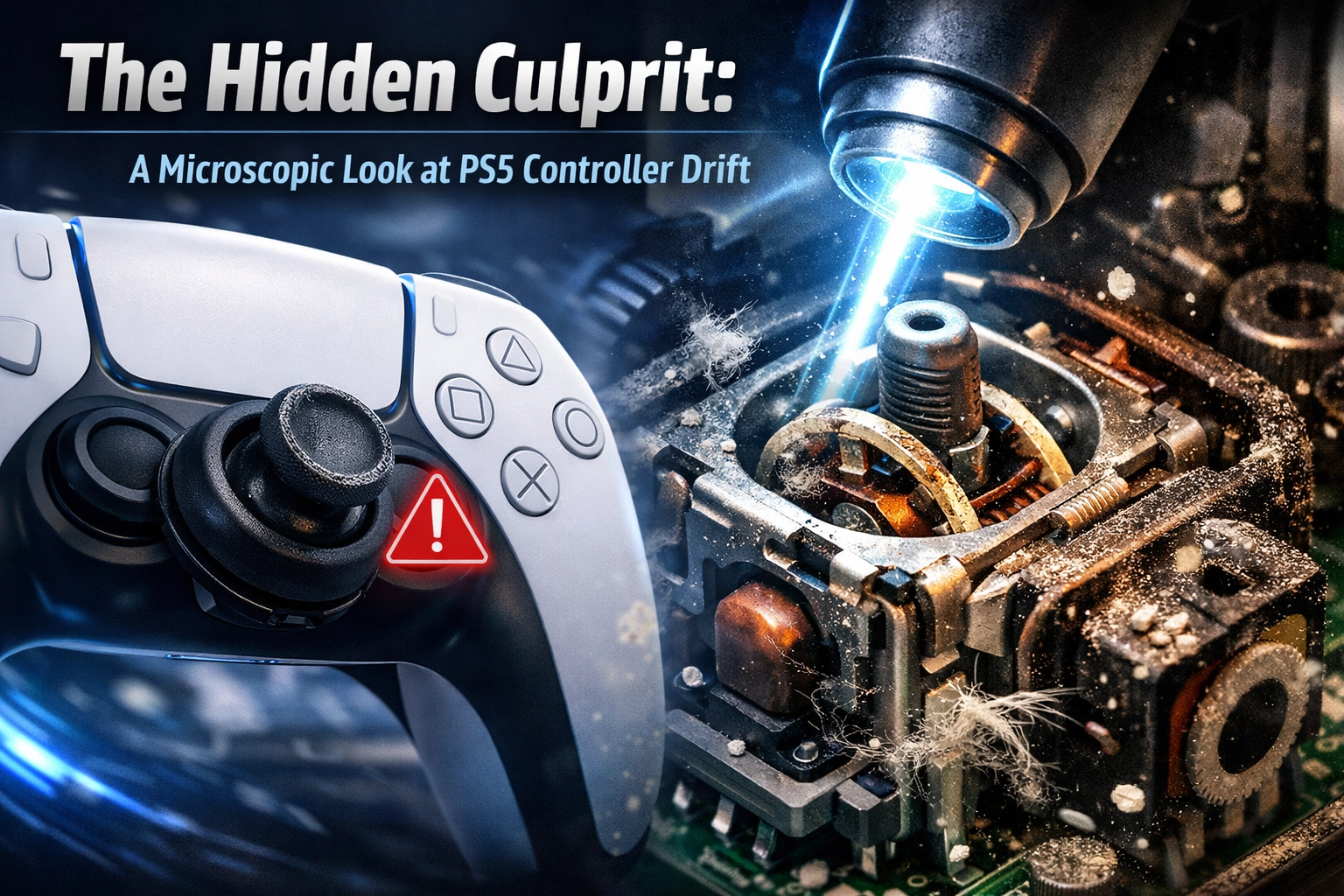
There you are, inches away from the final boss, your palms are sweaty, and your heart is racing. You’ve put in thirty hours of gameplay to get to this moment. You go to line up that perfect headshot, but suddenly, your character starts slowly wandering to the left as if they’ve spotted a shiny nickel on the floor. You didn't touch the stick. You’re fighting the camera just as much as the enemy.
Welcome to the world of PS5 joystick drift.
It’s the silent killer of gaming sessions and the number one reason we see DualSense controllers landing on our workbench here at Second Wind Sales and Services. If you live around Lethbridge, you know that a steady wind is just part of life, but when that wind starts blowing inside your favorite controller, it’s a recipe for a bad afternoon.
Today, I’m taking you behind the scenes, or rather, under the lens. We’ve recently upgraded our lab with a high-end electronics microscope, and what we’re seeing at 50x magnification explains exactly why your "quick fix" at home might be doing more harm than good.
The Science of the "Ghost in the Machine"
To fix a problem, you’ve got to understand the mechanics. Most people think a joystick is just a plastic nub, but underneath that dome is a complex piece of electromechanical engineering. The primary culprit for drift is a component called a potentiometer.
Inside your PS5 controller, there are two potentiometers for each stick (one for the X-axis and one for the Y-axis). These little sensors work using a wiper mechanism that moves back and forth across a resistive track. Think of it like a record player needle moving across a vinyl. Every time you move your stick, that wiper is scrubbing against the pad to tell the PS5 exactly where you’re pointing.
Why It Fails: The Microscopic Reality
As we’ve seen under our new microscope, modern controllers are built for precision, but not necessarily for eternal life. Here is what's actually happening at a microscopic level:
- Mechanical Wear: Over time, that constant friction creates microscopic grooves and scratches on the resistive pad. This alters the voltage readings sent to the console. If the voltage isn't steady, the PS5 thinks you're moving the stick even when it’s centered.
- The "Plastic Dust" Epidemic: The joystick housing is plastic. As you grind the sticks against the edges during an intense session of Call of Duty or Elden Ring, you’re actually creating a fine plastic dust. This dust migrates into the sensor housing, acting like sand in a delicate engine.
- Spring Fatigue: The spring that pulls your stick back to center is under constant tension. Eventually, it loses its "snap," creating a new, slightly off-kilter "neutral" position.

A look through our new microscope at the surface-mount components (SMD) on a PS5 controller PCB. At this scale, even a single speck of dust can look like a boulder.
The "Hard Way" vs. The Right Way
When drift starts, many gamers head to YouTube. You’ll find "tutorials" suggesting you spray WD-40 or rubbing alcohol into the stick. Pro-tip: Please, for the love of your hardware, don't do that. While a blast of compressed air might help temporarily, liquids can turn that internal plastic dust into a gunk that permanently ruins the sensor tracks.
The real fix? It involves opening the beast up. But the DualSense isn't like the controllers of the 90s. It’s packed with haptic motors, adaptive trigger assemblies, and a motherboard that is incredibly sensitive to heat and static.
The Micro-Soldering Difference
This is where PS5 controller repair becomes an art form. Most local shops won't touch joystick replacements because it requires high-level micro-soldering. Unlike a simple desktop computer part, the joystick module is soldered through the board at 14 different points.
If you use a standard soldering iron, you risk "lifting a pad." This is a technician's nightmare. The "pad" is the tiny copper circle on the circuit board that the component actually connects to. If that pad is gone, the electrical path is broken.

This is what happens when a DIY repair goes wrong. Under the microscope, you can see a damaged through-hole pad. Without the right equipment, this controller would be headed for the landfill.
Handling the "Unfixable"
At Second Wind, we pride ourselves on tackling the jobs other people won't touch. We see a lot of "failed DIYs" where someone tried to swap their own sticks and ended up ripping the delicate copper traces right off the board.
In the industry, many would call this "unfixable" and tell you to buy a new $90 controller. We disagree. Using our microscope, we can perform trace repair. We use hair-thin copper wire (literally thinner than a human hair) to bridge the gap and restore the connection.

Before we even hit the microscope for precision surgery, this is what we’re dealing with: a modern controller packed tight with motors, triggers, ribbon cables, and a maze of tiny parts that all have to go back together just right.
When we perform a joystick drift fix, we aren't just cleaning it. We are removing the entire failed mechanical unit and soldering in a brand-new, high-quality replacement. We then calibrate the center point to ensure it’s actually better than when it left the factory.
Why Does This Matter?
You might be wondering, "Cody, why go to all this trouble for a controller?"
It comes down to two things: Sustainability and Performance.
Modern electronics are becoming increasingly "disposable," but that doesn't mean they should be. Every controller we save is one less piece of e-waste in our Alberta soil. Plus, once you’ve broken in a controller, you’ve got muscle memory for those buttons. Replacing the guts while keeping the shell you love is the best of both worlds.
Our process is simple but thorough:
- Intake & Testing: We plug the controller into software to visualize the drift "noise."
- The Deep Clean: We remove the shell and give it a bath to get rid of the "gamer gunk" (don't worry, we've seen it all).
- Precision Surgery: Using our micro-soldering station and the new microscope, we swap the old potentiometers or the entire stick assembly.
- Stress Testing: We don't just fix it and hand it back. We run it through a battery of tests to make sure the drift is gone for good.
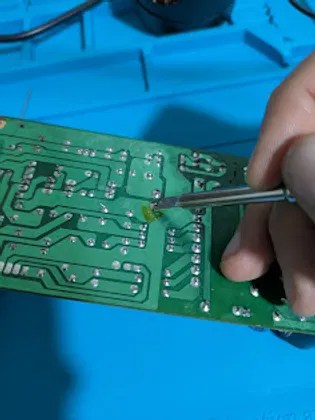
Precision is the name of the game. Our technicians use steady hands and professional-grade stations to ensure every solder joint is perfect.
A Neighborly Word of Advice
If you're starting to feel that "drift" or "ghost movement," don't wait until you've thrown the controller across the room in frustration. Often, catching the issue early means we can save the original board before the wear and tear becomes catastrophic.
And hey, if you’ve already tried to fix it and things went south: don't be embarrassed! We’ve all been there, thinking "how hard can it be?" only to realize we're staring at a board full of tiny components we can barely see. Whether it's a laptop repair or a gaming console, we're here to give your tech its "second wind."
Ready to Get Back in the Game?
Don't let a microscopic piece of dust or a worn-out sensor ruin your K/D ratio. If your PS5 controller is acting up, or if you have any other electronics that need a "tech wizard" touch, come see us. We treat every device like it's our own, with the patience and precision it deserves.
You can check out our full range of services or jump straight to booking an appointment. We're located right here in Lethbridge, ready to help you save your gear rather than replacing it.
Stay sharp, keep your sticks centered, and we'll see you at the shop!
Cody Woodman
Owner, Second Wind Sales and Services
Leave a Reply