
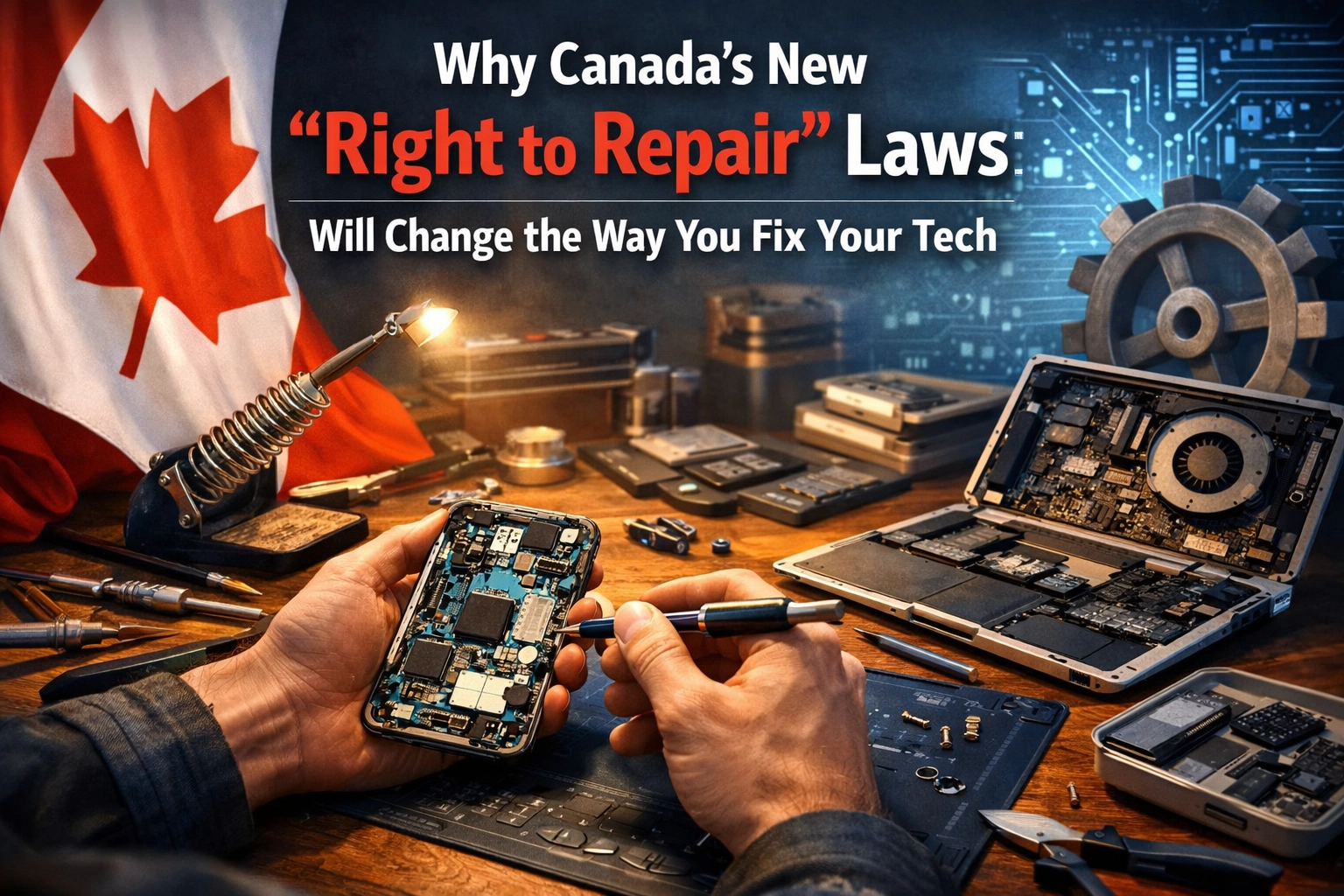
Have you ever had that sinking feeling when your smartphone takes a tumble onto the sidewalk, or your laptop decides to start acting like a very expensive paperweight right before a big deadline? We’ve all been there. Usually, the next step involves a frustrating trip to a “genius” bar or a “certified” center, only to be told that it’s cheaper to just buy a new one.
Well, friends, the winds are shifting. Here at SECOND WIND SALES AND SERVICES, we’ve always believed that if you bought it, you own it: and that includes the right to fix it. Thankfully, the Canadian government is finally catching up to that way of thinking. New “Right to Repair” laws are rolling out across the Great White North, and they are going to change the game for how we handle our gadgets.
I’m Cody, and I’ve spent more hours than I can count under the hood of various electronics. I’ve seen the “digital locks” and the “pentalobe screws” designed specifically to keep folks like us out. Today, I want to break down what these new laws mean for you, your wallet, and our beautiful planet.
What Exactly is “Right to Repair”?
In the simplest terms, the Right to Repair is a movement aimed at forcing manufacturers to make their products fixable. For years, big tech companies have made it increasingly difficult for independent shops (like yours truly) or DIY enthusiasts to perform even basic maintenance. They do this by withholding parts, hiding repair manuals, and using software “locks” that prevent a new part from working unless it’s “serialized” by the manufacturer.
Imagine buying a truck, but the hood is welded shut, and only the original dealership has the special torch to open it. That’s essentially what’s been happening with our phones and computers.
The new legislation, specifically Bill C-244 at the federal level and various provincial bills like Ontario’s Bill 91 and Quebec’s Bill 29, is designed to cut those welds. It’s about giving you the keys back to the kingdom: or at least the keys to your own laptop.
The Federal Win: Breaking the Digital Locks
One of the biggest hurdles in the world of computer repair services hasn’t been the hardware; it’s been the software. Manufacturers often use something called “Technological Protection Measures” (TPMs). These are digital locks that prevent people from accessing the software that runs the hardware.
In November 2024, Canada passed Bill C-244. This was a massive win! It created a permanent exception to copyright law, making it legal for you or a technician to bypass these digital locks for the purpose of diagnosis, maintenance, or repair.
Pro-tip: This doesn’t mean it’s legal to pirate software. It just means that if your tractor or your MacBook needs a software handshake to recognize a new screen, we can finally perform that handshake without the manufacturer breathing down our necks.
Provincial Power: Ontario and Quebec Lead the Charge
While the federal government handles the “digital” side of things, provinces are tackling the “physical” side.
Quebec really set the pace with Bill 29. They’ve gone as far as prohibiting “planned obsolescence”: that annoying practice where companies design things to break right after the warranty expires. They are also requiring manufacturers to make repair parts and manuals available at a reasonable price.
Ontario followed suit with Bill 91 (the Right to Repair Act, 2025). This law covers everything from your toaster to your motor vehicle. It mandates that if a company sells a product in Ontario, they have to provide the tools and documentation needed to fix it. This makes looking for phone repair near me a much more fruitful search, as independent shops will finally have the same resources as the big-box “authorized” centers.

Why This Matters for Your Wallet
Let’s talk brass tacks: money. When manufacturers have a monopoly on repairs, they can charge whatever they want. We’ve seen cases where a simple laptop battery repair at an authorized center costs 60% of the price of a brand-new machine.
By opening the market to independent shops and DIYers, competition goes up and prices come down. When we have access to the same diagnostic tools and genuine parts as the manufacturer, we can offer professional, high-quality fixes at a fraction of the cost.
Giving your device a “second wind” isn’t just a catchy name for us: it’s a financial strategy for you. Why spend $1,200 on a new phone when a $150 screen replacement can make your current one feel like new?
Saving the Planet, One Gadget at a Time
Beyond the money, there is a massive environmental angle here. Every time a “unfixable” laptop gets tossed in the bin, it contributes to the growing mountain of global e-waste.
Electronic waste disposal is a huge challenge. Many devices contain heavy metals and chemicals that shouldn’t be in our soil or water. While we pride ourselves on being an electronics recycling center that handles things responsibly, the best form of recycling is reusing.
The most eco-friendly phone is the one you already have in your pocket. By extending the life of our electronics by just a couple of years, we drastically reduce the demand for mining rare earth minerals and the energy required for manufacturing.
How We Give Your Gear a “Second Wind”
At SECOND WIND SALES AND SERVICES, we’ve been practicing the “Right to Repair” philosophy long before it was a law. We hate seeing perfectly good tech go to waste just because a tiny capacitor blew or a charging port got wiggle-loose.
Whether you need professional laptop repair in Lethbridge or you’re looking for phone repair, we’re here to help. These new laws mean we can do our jobs even better.
- iPhone Screen Replacement: No more “Unknown Part” warnings when we swap a screen.
- Laptop Battery Repair: Access to genuine calibration tools to ensure your new battery lasts as long as the original.
- Game Console Fixes: From HDMI ports to disc drives, we’ve got the parts and the know-how.
We even deal in the fun stuff. If your tech is truly beyond saving, we might be able to help you trade it toward something “new-to-you” from our collection of vintage consoles or even cool collectibles.
The Easy Way vs. The Hard Way
I always like to give my neighbors options. When your tech breaks, you generally have two paths:
The Hard Way (The “Old” Way):
- Spend an hour on hold with a manufacturer.
- Drive to a mall and wait in line.
- Get told your 3-year-old device is “vintage” and parts aren’t available.
- Pay a “diagnostic fee” just for them to tell you to buy a new one.
- End up at an electronics recycling center with a perfectly good screen and a broken heart.
The Easy Way (The “Second Wind” Way):
- Give us a shout or contact us online.
- Bring your device into a local shop that actually cares about fixing things.
- Benefit from the new Right to Repair laws that give us the parts and manuals we need.
- Get your device back quickly, working like a charm, and with money left in your pocket.

Don’t Toss It: Fix It!
The “Right to Repair” isn’t just a win for tech geeks; it’s a win for every Canadian who is tired of the “planned obsolescence” cycle. It empowers you to be a smarter consumer and a better steward of the environment.
Next time your computer starts acting up, don’t assume it’s the end of the road. It might just need a little TLC. Check out our 10 reasons for a slow computer to see if it’s an easy fix you can do at home, or bring it by the shop.
We’re excited to see where these laws take our industry. It means more transparent repairs, better parts availability, and a world where “disposable” isn’t the default setting for electronics.
If you’re in the neighborhood and need a hand with a repair, or if you just want to geek out about the latest legislation over a coffee, come see us. We’re here to make sure your tech gets that much-deserved second wind!
Cody Woodman
Owner, SECOND WIND SALES AND SERVICES
Leave a Reply