
If you walk into a blacksmith’s shop from two hundred years ago, you’d find a room filled with the smell of coal, the glow of a hot forge, and the rhythmic clink-clink-clink of a hammer hitting an anvil. The blacksmith wasn’t just a guy with a heavy arm; he was the person who kept the community running. If your plow broke, you didn’t throw it away and buy a new one from a catalog, you took it to the smithy. He’d heat it, beat it, and fuse the metal back together. He understood the soul of the iron.
Fast forward to 2026. If you walk into Second Wind Sales and Services, you won’t find a coal forge (thankfully, because the smoke detectors would go crazy), but the spirit is exactly the same. Instead of a massive anvil, we have a precision workbench. Instead of a heavy hammer, we have a surgical-grade micro-soldering station.
We are the modern-day blacksmiths of the digital age. While the rest of the world tells you to “just upgrade” or “buy a new one,” we’re sitting here under a microscope, breathing new life into the “iron” of our time: the silicon motherboard.
The Art of the Micro Solder
When people hear the word “repair,” they usually think of swapping a screen or popping in a new battery. That’s the easy stuff. In the industry, we call that “parts swapping.” It’s like changing a tire on a truck. But what happens when the engine block is cracked? Most shops will tell you the truck is totaled.
That’s where micro-soldering comes in.
Micro-soldering is the high-stakes art of repairing the actual logic board of your device. We’re talking about components that are sometimes smaller than a grain of salt. To do this, we don’t just need steady hands; we need a specialized set of tools that would make a jeweler jealous.

The Microscope: Our Window into a Tiny World
You can’t fix what you can’t see. Our electronics microscope is the heart of our “forge.” It allows us to zoom in and see the tiny traces, the “roads” of electricity, that run through your laptop or phone.
When a device gets dropped, or more commonly, when it meets a cup of coffee it wasn’t supposed to drink, those tiny traces can break or corrode. To the naked eye, the board looks fine. Under the microscope, it looks like a disaster zone. Being able to perform a micro solder repair means we can find that one tiny, microscopic break and bridge it, restoring the connection and bringing the whole device back to life.
Why Big-Box Stores Want You to Move On
We’ve all been there. You take your “dead” laptop to a big-box retailer. The “Genius” or the “Agent” looks at it for five minutes and says, “Yeah, the motherboard is shot. It’ll cost $800 to fix, so you might as well just buy this new model over here for $1,000.”
It feels like a punch in the gut, right?
The reason they do this isn’t necessarily because they’re mean (though the sales commission helps). It’s because they aren’t blacksmiths; they’re assembly line workers. They don’t have the tools, the time, or the specialized micro-soldering skills to actually repair a board. It’s much faster and more profitable for them to sell you a whole new unit than to spend two hours under a microscope fixing a $2 capacitor.
At Second Wind, we take pride in being the alternative. We’d much rather spend the time to save your board than watch another perfectly good piece of tech head to the landfill. If you’re in the Lethbridge area, you know that we value hard work and making things last. It’s the Southern Alberta way.
The Precision of the “Electronic Hammer”
In the old days, a blacksmith had to know exactly how much heat to apply. Too little, and the metal wouldn’t take shape. Too much, and you’d ruin the integrity of the tool.
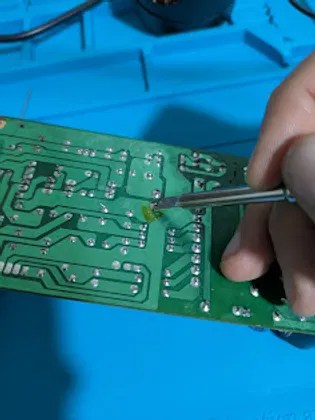
In micro-soldering, heat management is everything. We use high-end soldering irons and hot air rework stations that allow us to control the temperature down to the single degree. When we’re working on a professional laptop repair, we have to be careful not to “cook” the surrounding chips while we’re trying to melt the solder on a single pin.
It’s a dance of fire and precision.
The “Art” of Saving a Board
There’s a certain feeling of victory when a board that was declared “dead” by three other shops suddenly chimes to life on our bench. It’s like the modern version of a blacksmith forging a sword from a pile of scrap.
Whether it’s a PS5 controller drift fix that requires replacing tiny sensors on the internal board or a MacBook that won’t charge because of a blown chip, the process is the same:
- Diagnosis: Finding the “crack” in the iron.
- Preparation: Cleaning away the “rust” (corrosion).
- The Repair: The delicate application of the micro solder to bridge the gap.
- Testing: Making sure the “blade” holds its edge.
Sustainability: The Blacksmith’s Legacy
One of the coolest things about the old blacksmithing trade was that nothing went to waste. Old horseshoes became nails. Old saws became knives.
Today, we face a massive “e-waste” problem. Every time someone throws away a phone because of a tiny charging port issue or a laptop because of a “dead motherboard,” it adds to a mountain of trash that doesn’t need to exist.
By choosing a shop that specializes in micro-soldering, you’re making a choice for the planet. You’re saying that craftsmanship matters more than convenience. You’re keeping your tech out of the dirt and in your hands. Plus, let’s be real: it’s way cheaper.
Pro-Tip: If you’ve got a device that’s been sitting in a drawer because someone told you it was “unfixable,” bring it in. We love a good challenge, and “unfixable” is often just another word for “I don’t know how to micro-solder.”
Why Local Skills Beat Big-Box Replacements
When you support a local shop like Second Wind, you aren’t just paying for a service; you’re investing in a craft. We live here, we work here, and we care about our neighbors in Magrath, Milk River, and Lethbridge.
When you bring your tech to us, you’re talking to the person who is actually going to be doing the work. There’s no “sending it off to a depot” for three weeks. There’s no mystery. We’ll show you the microscopic photos of what’s wrong. We’ll explain the process.

The Technical “Magic”
To the average person, what we do looks like magic. You see a tiny puff of smoke (that’s the flux doing its job!), a flash of silver, and suddenly a dead device is alive again. But it’s not magic: it’s just the result of years of practice and a deep love for how things work.
Whether it’s recovering precious family photos from a phone that won’t turn on or saving a high-end gaming PC that took a power surge, the micro solder is the tool that makes it happen.
Don’t Let Your Tech “Rest in Peace” Just Yet
If your computer, phone, or console is acting up, don’t assume it’s a goner. It might just need a little “blacksmithing.”
We handle everything from the simple stuff to the incredibly complex board-level repairs. We’ve got the microscopes, the irons, and the steady hands to give your devices a Second Wind.
- Got a slow computer? We can fix that.
- Got a broken HDMI port? We can micro solder a new one on.
- Got a device that won’t turn on? Let us take a look under the scope.
Ready to see what a modern-day blacksmith can do for your tech? Swing by the shop or contact us today to book your diagnostic. Let’s keep your gear running and your wallet happy.
Keep it local. Keep it repaired. Keep it running.
Leave a Reply